
Queensland Co-Living case studies · 2026
Three Keys. All Three Have to Be Right.
Real rents, yields, build times, leasing results and finance from five-room Co-Living homes across Brisbane and South East Queensland.
By Stephen Lazar · properT network
Rooming houses and Co-Living homes can produce some of the strongest yields in residential property. Rent comes in by the room, not by the house, so income is spread across several tenants and holds up better when one leaves.
That only works when three things are right: location, design and management. Below is each one, with a real Queensland project behind it, followed by how these homes are financed. Every figure comes from completed projects, leasing reports and lender quotes supplied to properT network between mid-2025 and September 2026.
Gross yields are before outgoings. Results vary by property, and past performance does not guarantee future results.
What Has to Line Up
1. Location
Where room demand outruns room supply.
2. Design
Space that shapes how tenants live together.
3. Management
Rooms filled fast, and kept filled.
Room Demand Is Not House Demand
Tenants rent by the room where they work, study and can get around without a car. A suburb that suits a family home is not automatically a suburb that suits Co-Living. The best projects sit on infill sites in established suburbs, close to rail, busways, hospitals and universities, where the data shows room supply is short. Our Brisbane and South East Queensland Co-Living guide covers where we look.
Case study: Deagon, Brisbane north (purchased June 2025)
A five-room home bought as a house and land package for $1,068,900, tracked over its first 12 months at 98% average occupancy.
| Deagon | At purchase | 12 months later |
|---|---|---|
| Average rent per room / week | $400 | $446 |
| Total rent / week | $2,030 | $2,230 |
| Rent / year at 98% occupancy | $103,449 | $113,641 |
| Gross yield | 9.68% | 10.63% |
| Total annual outgoings | $23,730 | $24,648 |
| Net income before finance | $79,718 | $88,993 |
| Net yield | 7.46% | 8.33% |
The outgoings matter as much as the rent. This is what a five-room home actually costs to run each year:
| Annual outgoings (Deagon) | Cost |
|---|---|
| Management fees (9%) | $10,228 |
| Building and landlord insurance | $3,500 |
| Council rates and water service charges | $3,000 |
| Water usage | $2,400 |
| Gardening and cleaning | $2,350 |
| Internet | $1,320 |
| Electricity (with 13.3kW solar) | $1,100 |
| Fire safety and smoke alarms | $450 |
| Pest inspections | $300 |
| Total | $24,648 |
Utilities are usually included in room rent, so the owner pays them. That is why net yield, not gross, is the number to compare.
Case study: Bald Hills, Brisbane north (first let August 2025)
A five-room house and land package with a total investment of $1,263,900, built in 146 days from slab to practical completion.
| Bald Hills | First letting (Aug 2025) | July 2026 |
|---|---|---|
| Rent per room / week | $416 | $470 |
| Total rent / week (5 rooms) | $2,080 | $2,350 |
| Rent / year | ≈$108,600 | ≈$122,000 |
| Gross yield on total cost | 8.6% | 9.7% |
Rent at Bald Hills rose $54 per room per week, about $14,000 a year across five rooms. Because Co-Living homes are often valued on income, small rent changes move value: at a 7% capitalisation rate, every extra $10 per room per week adds roughly $37,000 of estimated value. That works in reverse too, which is why location and demand come first.
Valuations on an income (capitalisation) basis are estimates only, not bank valuations. Banks may value a rooming house differently.
In a Shared Home, Behaviour Follows Space
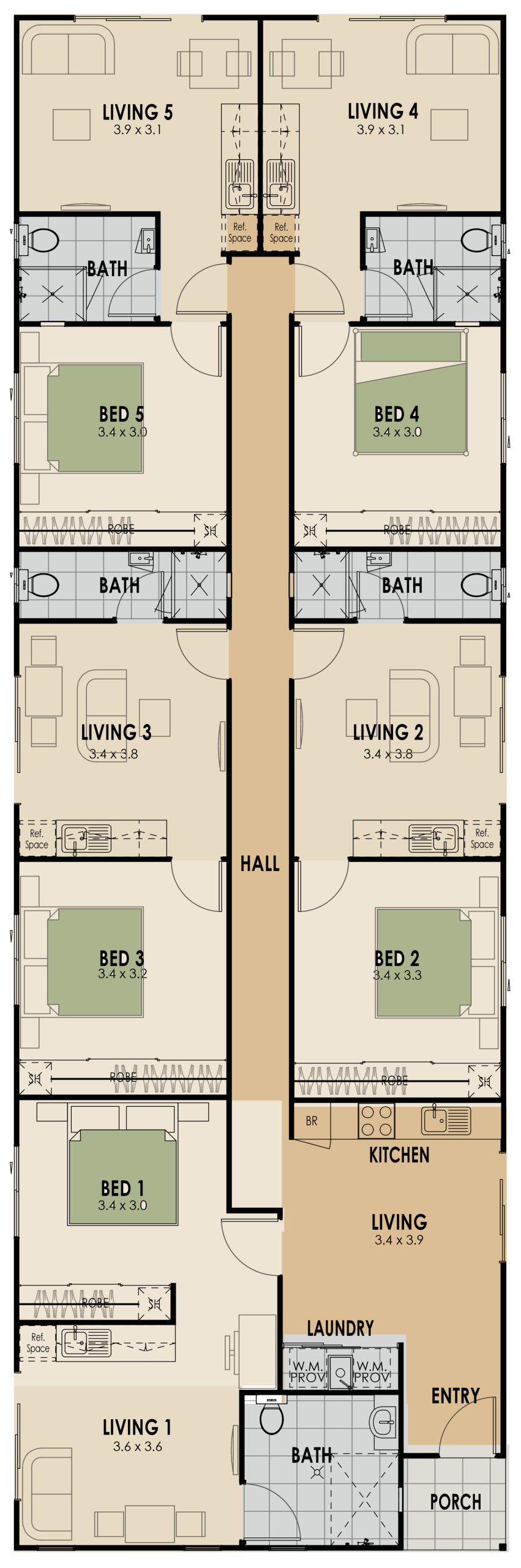
Most tenant friction starts as a layout problem, not a people problem. The five-room design behind these case studies answers it with space: each tenant gets around 22m² of private bedroom and living area, plus their own bathroom.
1. Access
One central hallway runs the length of the home and every suite opens off it. No tenant walks through another tenant’s space to reach their door.
2. Boundaries
Each suite is a bedroom, a separate living room with kitchenette, a bathroom and a robe. Robes and bathrooms sit on the walls between suites to cut noise.
3. Balance
Every bedroom is 3.4m x 3.0m and every living room 12 to 13m². Nobody draws the short straw, so rents hold across every room.
The shared kitchen, dining and laundry sit together at the entry, away from the rear suites. Compare this with other layouts on our Co-Living properties page.
Case study: Geebung, Brisbane north (completed July 2026)
A returning investor built the same five-room design on land they already owned. The build reached practical completion 156 days (just over 22 weeks) after the piers were finished.
| Build stage | Completed |
|---|---|
| Piers | 25 Feb 2026 |
| Slab | 11 Mar 2026 |
| Frame | 17 Mar 2026 |
| Roof | 8 Apr 2026 |
| Enclosed | 11 May 2026 |
| Fixing | 5 Jun 2026 |
| Practical completion | 31 Jul 2026 |
| Certificate of occupancy | 4 Aug 2026 |
Geebung rents are advertised, not yet confirmed achieved income. The total excludes legal, finance and holding costs. Build time runs from completed piers, not from contract signing.
One House. Several Tenancies.
A standard rental manager is set up for one lease per house. A Co-Living home has five, each with its own move-in, rent and notice dates. Specialist rooming house management fills rooms fast and keeps them filled.
Leasing results: five brand-new homes in SEQ (September 2026)
| Suburb | Rooms | Days to lease | Rent / week |
|---|---|---|---|
| Coopers Plains (two homes) | 10 | 31 | $4,500 |
| Ashgrove | 5 | 7 | $2,495 |
| Lawnton | 5 | 17 | $2,270 |
| Northgate | 5 | 20 | $2,405 |
| Total | 25 | $11,670 |
All new homes with no leasing history. Ashgrove is measured from furniture installation, the others from the first day on market. Several listings went live before handover, so part of each campaign was lost to settlement and furnishing.
Across the portfolio, that is $606,840 a year in combined gross rent. Ashgrove had three pre-approved tenants ready to sign before the home was furnished.
The manager’s headline vacancy rate was 5%, but most of that is brand-new homes leasing up for the first time. True vacancy, counting only rooms being re-let after a tenant leaves, was 1.53%. In most cases the next tenant signs before the last one moves out. Genuine gaps usually come from break leases late in a tenancy, where notice can be as short as 1.5 to 2 weeks.
A Residential Asset With Commercial Returns
That combination is the appeal. It is also why finance needs a specialist broker. Lenders do not all treat a rooming house the same way, and the wrong one can cost borrowing power before the build starts.
Lender
Not every lender takes rooming houses, and policy differs between those that do.
Income
How much room-by-room rent counts toward borrowing capacity varies from lender to lender.
Structure
A split contract means a land loan and a construction loan, set up correctly from day one.
Worked example: $1,295,000 Queensland house and land
Land $695,000 plus build $600,000, funded in a company’s name at 58.7% LVR ($760,000 construction loan). Conditional approval took 3 working days, and settlement about 5 weeks from submission. The deposit and duty came from equity in the client’s existing investment properties.
The construction loan is 8.49% interest only, but interest is charged only on what has been drawn. Because the client’s equity paid for the land first, the loan grew with each builder progress payment:
| Stage (month) | Loan drawn | Interest that month |
|---|---|---|
| Land settlement + 5% deposit (1) | $190,000 | $1,344 |
| Base, 15% (3) | $280,000 | $1,981 |
| Frame, 20% (5) | $400,000 | $2,830 |
| Lock-up, 20% (7) | $520,000 | $3,679 |
| Fixing, 20% (9) | $640,000 | $4,528 |
| Practical completion, 20% (12) | $760,000 | $5,377 |
Staged drawdowns saved about $25,900 in the first year. At an 8.21% gross yield (about $106,320 a year), the property was projected to turn cash-flow positive after tax once tenants moved in, for that client’s tax position.
How much deposit? The LVR trade-off
Indicative quotes for the same $1,295,000 package, with LVR measured on land plus build. Stamp duty and costs are paid on top.
| LVR | Loan | Your contribution | Rate after build | P&I / month |
|---|---|---|---|---|
| 75% | $971,250 | $323,750 | 8.19% | $7,256 |
| 70% | $906,500 | $388,500 | 8.19% | $6,772 |
| 65% | $841,750 | $453,250 | 7.69% | $5,996 |
| 60% | $777,000 | $518,000 | 7.69% | $5,534 |
Going from 70% to 65% LVR takes $64,750 more equity, but the rate drops from 8.19% to 7.69%. Together with the smaller loan, that saves about $776 a month.
Rates are variable and indicative as at September 2026, subject to lender approval and valuation. Construction is quoted at 8.49% interest only. Not a loan offer or credit advice.
What These Case Studies Don’t Tell You
These are good results, and they are real. But a case study shows a project that worked. Before you rely on numbers like these, weigh up:
- Advertised vs achieved rent. New-build rents are often advertised before they are achieved. Ask for signed leases.
- Gross vs net. The owner usually pays utilities, internet, cleaning and higher management fees. Deagon’s $24,648 a year in outgoings turned a 10.63% gross yield into 8.33% net.
- Valuation and resale. Income-based valuations are estimates. Fewer lenders and buyers compete for rooming houses, which can affect bank valuations and your exit.
- Compliance. In Queensland a home with four or more residents renting rooms is generally a residential service, which must be registered and accredited. Read our Co-Living and rooming house rules by state.
- Finance. Rates are higher than a standard investment loan, and serviceability rules vary widely between lenders.
We cover the risks openly in Why I wouldn’t invest in a Co-Living property and our Co-Living investment guide.
Current Queensland opportunities
See the Current Co-Living Packages
We have access to current five-room Co-Living and rooming house packages across Brisbane and South East Queensland, on fixed-price split contracts, with specialist management and finance lined up before you commit. Talk to Stephen first, and we will tell you honestly whether Co-Living suits your goals.
- Project case studies for Deagon, Bald Hills and Geebung, and a leasing performance report for five SEQ homes, supplied to properT network, July to September 2026
- Rooming house finance case studies and indicative loan quotes from a specialist broker, September 2026
- properT network, Co-Living Property Explained, Warts and All
- Investment Property Queensland: Brisbane research
General information only, not financial, tax, lending or legal advice. Figures are project-specific, rounded and based on information supplied at the dates shown. Rents may be advertised rather than achieved, and valuations are estimates, not bank valuations. Property investment carries risk, and past performance is not a guarantee of future results. Seek independent advice before making any decision.
Co-Living Case Study FAQs
What rent does a Co-Living room earn in Brisbane?
In these 2026 Brisbane and SEQ case studies, new five-room homes achieved $446 to $499 per room per week, with a portfolio average of $466.80 across 25 brand-new rooms.
What yield does a Queensland rooming house return?
Gross yields in these case studies ranged from 8.6% to 10.63%. After outgoings of about $24,648 a year, the Deagon home returned an 8.33% net yield.
How long does it take to lease a new Co-Living home?
Five brand-new SEQ homes were fully leased in 7 to 31 days, and vacancy on re-let rooms was 1.53%.
Related Reading
- Co-Living Investment Brisbane & South East Queensland
- Co-Living Property Return on Investment
- Co-Living & Rooming House Rules by State
- Brisbane Co-Living Returns 2026: 5 Lessons (Investment Property Queensland)
- Co-Living vs Traditional Property Investment

