
Brisbane and South East Queensland have some of the tightest rental markets in the country, fast population growth and a decade of infrastructure leading into the 2032 Olympic and Paralympic Games. For Co-Living investors, the region offers strong demand, but Queensland’s residential services rules mean compliance must be planned from day one.
Why Co-Living Works in Brisbane and SEQ
- Very tight rental market. Brisbane’s vacancy rate was 0.9% in August 2026, well below the national 1.3%.
- Population growth. South East Queensland is planning for around 2.2 million additional residents by 2046 (ShapingSEQ).
- 2032 Games and infrastructure. Transport, venues and precinct renewal are drawing jobs and workers into the region.
- Students and health workers. Major universities and hospital precincts across Brisbane, Ipswich, Logan and the Sunshine Coast.
The Numbers at a Glance
| Indicator | Figure |
|---|---|
| Brisbane rental vacancy rate (SQM Research, Aug 2026) | 0.9% |
| National rental vacancy rate (Aug 2026) | 1.3% |
| SEQ population growth to 2046 (ShapingSEQ) | ~2.2 million extra residents |
| Advertised Co-Living rent per suite (rental managers, 2026) | $350 to $370 per week |
| Typical Co-Living gross yields (properT network research) | 6% to 12%, depending on location, design and management |
For our wider Queensland research, see Investment Property Queensland.
What that rent means: rental managers are currently advertising Co-Living suites at around $350 to $370 per week. As an illustration only, a five-suite home at $360 per suite earns about $1,800 a week, or roughly $93,600 a year at full occupancy. At a more realistic 85% occupancy that is about $79,600 a year, before management, utilities, insurance, compliance and other outgoings. Rents vary by location, suite size and inclusions, so check current rents for the specific property.
See real results: rents, yields, outgoings, leasing times and finance from five-room homes in Deagon, Bald Hills, Geebung and other Brisbane suburbs in our Queensland Co-Living case studies.
Where We Look in SEQ
- Brisbane middle-ring suburbs near hospitals, universities and busway or rail. Brisbane research.
- Ipswich and Springfield, with large defence, logistics and health employment. Ipswich research.
- Logan and Moreton Bay, two of the region’s fastest-growing areas, close to jobs and the rail network.
- The Sunshine Coast, with its university and hospital precinct. Sunshine Coast research.
Rules You Need to Know
In Queensland, a property where four or more residents rent rooms and share facilities is generally a residential service. It must be registered with the Department of Housing, accredited (at least Level 1) within three months, and supported by a council building compliance notice and a fire safety plan. Residents sign rooming accommodation agreements (Form R18). Read our full guide: Co-Living & Rooming House Rules by State.
What Makes a Co-Living Property Worth Buying Here
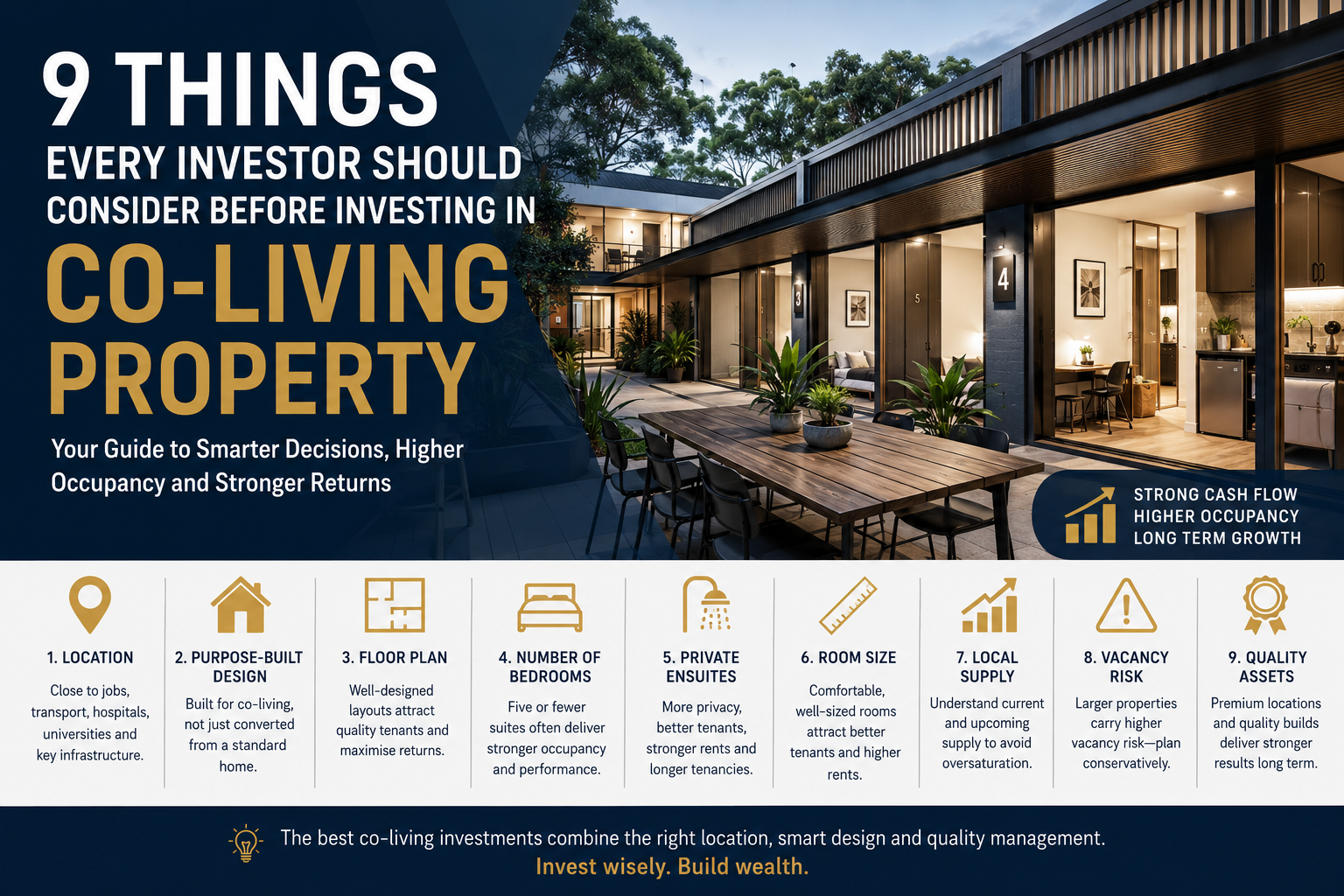
- Location first. Walking distance or a short trip to jobs, hospitals, universities and transport. Co-Living tenants rarely want to drive.
- Purpose-built design. Private suites with ensuites, good sound insulation and enough shared space. Converted older houses rarely compete.
- Not too many suites. In our experience, five or fewer suites tend to hold occupancy better than larger configurations.
- Compliance from day one. Registration, fire safety and minimum standards built in, not retrofitted.
- Realistic numbers. Model income at around 75% to 85% occupancy, not 100%, and include management, utilities and compliance costs.
- An exit. Know who will buy it from you. A property that also works as a family home or dual-income home has a wider resale market.
Read more: Co-Living Investment Guide: 9 factors to consider · Why I wouldn’t invest in a Co-Living property · Co-Living FAQs
Related Reading Across the properT network
- The Queensland Olympic effect
- Where to invest in Queensland property
- Investment property in South East Queensland
- Why Australia’s shared living boom is just getting started
Other Co-Living Locations
Co-Living in Melbourne · Co-Living in Geelong · Co-Living in Ballarat & Bendigo
Frequently Asked Questions
Is Co-Living a good investment in Brisbane?
Brisbane’s very low vacancy, strong population growth and the lead-up to the 2032 Games support demand for private rooms. As always, location, purpose-built design and compliance decide whether a property performs.
Is a Co-Living house in Queensland a residential service?
Generally yes, if four or more residents each rent a room and share facilities. The operator must register and accredit the residential service with the Department of Housing, and meet building and fire safety requirements.
Which parts of South East Queensland suit Co-Living?
Areas close to hospitals, universities, major employment and rail or busway, including parts of Brisbane, Ipswich, Logan, Moreton Bay and the Sunshine Coast.
Talk to Us Before You Buy
Co-Living can deliver strong income, but only when the location, the design, the compliance and the numbers all stack up. Book a complimentary strategy session with Stephen Lazar at properT network and we will tell you honestly whether Co-Living suits your goals.
Or call 0413 108 125.
Free download: The Co-Living Investor Checklist
36 checks to make before you buy a Co-Living or rooming house property: strategy, finance, location, state rules, management and exit. A free 9-page PDF from Stephen Lazar.
General information only. properT network does not provide personal financial, legal, tax or lending advice. Rules, rents and yields change and vary by property. Seek independent professional advice before making any decision.
