Co-Living vs Traditional Investment Properties: Which Investment Strategy Delivers Better Long-Term Results?
Introduction
For decades, Australian investors have relied on the traditional formula :
Buy a house.
Lease it to one family.
Wait for capital growth.
That strategy has built significant wealth for many Australians.
However, today’s property market looks very different.
Higher interest rates, increasing holding costs, persistent housing shortages and changing tenant preferences are encouraging investors to consider alternative investment strategies.
One of the fastest-growing is purpose-built Co-Living homes.
Rather than relying on a single tenant paying a single rent, co-living properties generate multiple income streams from individual residents while helping address Australia’s growing demand for affordable, flexible accommodation
Tenant Demand
Australia’s Housing Challenge Is Changing Investment Opportunities
Australia is experiencing historical :
- record migration has created a housing supply shortage
- shrinking household size, need for different accommodations to suit
- affordability challengescreates change
- dire rental shortages resulting in historical low vacancy rates
- more single-person households, idea of sharing is more prevalent and acceptable
- key workers seeking affordable accommodations / shared accommodations
- healthcare workers unable to secure or afford a suited rental property need Co-Living arrangements
- young professionals wanting to house share
All of these vital market fundamentals increases demand for shared housing.
Traditional Rental Model
| Feature | Standard Rental |
|---|---|
| One lease | ✔ |
| One tenant or multiple tenants | ✔ |
| One income stream | ✔ |
| 100% vacant when empty | ✔ |
| Rental increases annual | Usually |
| Vacancy risk | Can thus be higher |
Co-Living Model
| Feature | Co-Living |
|---|---|
| Multiple leases | ✔ |
| Multiple income streams | ✔ |
| Partial vacancy only | ✔ |
| Higher gross rental income | ✔ |
| Diversified rental risk | ✔ |
| Professional management | ✔ |
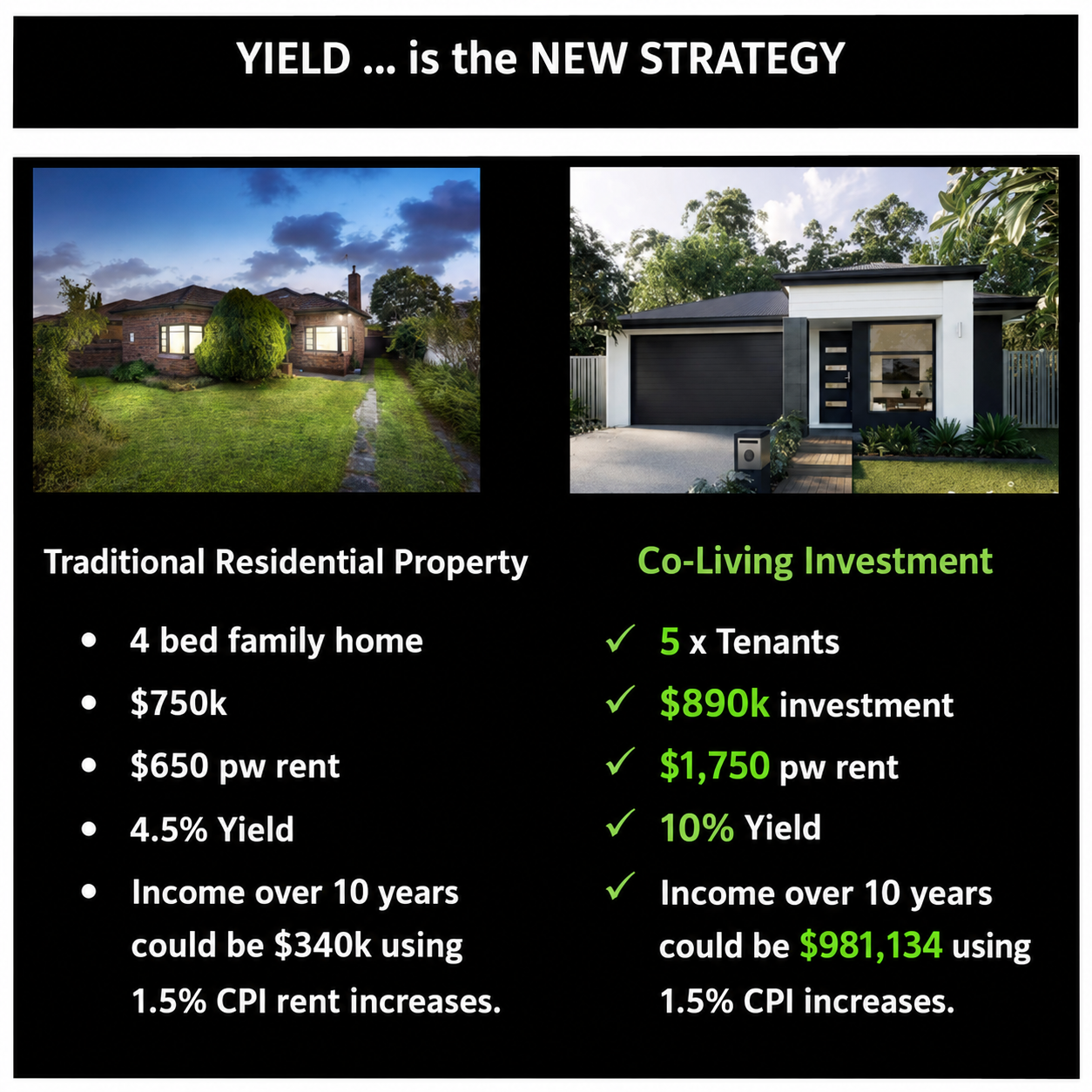
| Example Only | Standard Home | Co-Living |
|---|---|---|
| Purchase Price | $850,000 | $950,000 |
| Weekly Rent | $700 | $1,750 |
| Gross Yield | 4.3% | 9.57% |
| Vacancy Impact | 100% | 20% |
| Rental Streams | 1 | 5 |
Data Comparison
*The figures above are illustrative only. Actual performance varies depending on location, design, management, occupancy, operating costs and market conditions.
Beyond Cash Flow
Co-Living offers improved income resilience
Co-Living homes offer improved income resilience, meaning If one tenant leaves, 4 tenants remain in place, you still earn 80% of rental income potential until that tenant is replaced. Think about it “if one tenant leaves and you miss out on $350 pw rental income on that tenant; you still earn 4 x $350 pw = $1,400 pw.
On a family home, if you are returning 4.3% or $700 pw, the Co-Living with only 80% occupancy is returning you $1,400 pw or 7.6% yield.
If your tenant on your Traditional rental home leaves, 100% of income disappears.
View potential CoLiving Return on Investment blog here.
Stronger Borrowing Capacity and Return on Investment
For many investors, the biggest challenge isn’t finding the next investment property—it’s securing finance to buy it.
Today’s lenders don’t simply assess how much equity you have in your existing properties. Instead, they evaluate your overall financial position, including your income, living expenses, existing debts and the cash flow generated by your investment portfolio.
This is where the type of investment property you choose can have a significant impact.
A traditional investment property generating a gross rental yield of around 4–5% may still require ongoing financial support from your personal income, particularly in the early years of ownership. While negative gearing can provide tax benefits for some investors, the property’s cash flow may reduce your overall borrowing capacity because lenders assess your ability to comfortably service all existing and future debt.
By comparison, a well-designed and located Co-Living property generating a higher gross rental yield—often around a conservative 6.5% or more, depending on the location, design and occupancy—may produce stronger positive cash flow after expenses. This additional income can strengthen your financial position and, subject to your lender’s assessment and lending policies, may improve your borrowing capacity sooner than a lower-yielding investment.
There is another important consideration.
Purpose-built CoLiving properties that achieve strong rental returns may also attract higher valuations once completed and fully tenanted, particularly where valuers recognise the property’s income-producing capacity. If this creates additional equity, investors may be able to use some of that equity towards the deposit on their next investment, subject to lender approval.
Traditional Investment Property
- Often generates lower rental yields.
- May require ongoing financial contributions from your personal income.
- Can reduce borrowing capacity if the property has a negative cash flow position.
- Investors may need to wait longer before they can comfortably finance their next purchase.
- During that time, property prices may continue to rise, potentially increasing the cost of entering the market again while also missing additional rental income, depreciation benefits and capital growth opportunities.
Co-Living Investment Property
- Typically generates higher rental income through multiple income streams.
- With multiple tenant occupancy, provide stronger positive cash flow, depending on occupancy, operating costs and management.
- Stronger cash flow can support serviceability assessments and may assist with borrowing capacity, subject to lender criteria.
- Potential equity growth and improved cash flow may enable investors to expand their property portfolio sooner.
- Acquiring quality investment assets earlier allows investors to benefit from the long-term effects of compounding capital growth and rental income over time.
While every investor’s financial circumstances are different, and lending decisions are ultimately made by individual lenders, many experienced investors recognise that improving cash flow is one of the most effective ways to strengthen a property’s long-term investment performance and increase future investment opportunities.
Institutional Investment
This is a huge trend.
Knight Frank reports the Australian CoLiving pipeline has exceeded 10,000 units, with thousands more under construction or approved, indicating that institutional investors increasingly view the sector as a long-term residential asset class.
Risk Comparison
| Traditional | Co-Living |
|---|---|
| Lower management | Higher management |
| Lower rent | Higher rent |
| Lower yield | Higher yield |
| Easier finance | Depends on product |
| Simpler leasing | Multiple leases |
| Lower Depreciation | Higher Depreciation |
Is CoLiving Right For Every Investor?
No, and neither are many of the Co-Living homes being touted out there … importantly see why here.
Say that.
Instead
It suits investors who:
✔ prioritise cash flow
✔ have higher servicing costs
✔ want income diversification
✔ plan long-term holds
✔ understand active asset management
Conclusion
There is plenty to be aware of when wanting to invest in a CoLiving property – read what here.
On the other hand, an astutely chosen LOCATION and a purposefully designed Generous FLOOR PLAN could ensure that your investment is one of Australia’s sought after high CASH FLOW property investment.Helping investors create lasting wealth see why here.
Co-Living Property is an investment strategy that requires understanding, whilst avoiding potential greed of touted high yields and lower entry into the market products.
CoLiving Investment suits investors who :
✔ prioritise cash flow as a preferred investment strategy
✔ have higher servicing on current portfolio or home loan
✔ want income diversification
✔ looking to grow and secure wealth more efficiently
✔ understand the importance of Location, current and intended Supply and Floor plan
.
Budget 2026-27 Negative Gearing explained
Why I would not invest in a Co-Living Property … and or why I would
Rental Guarantees and Co-Living Property Investment
The Rise of High-Yield Investment Property Strategies
Autumn 2026 Property Market Insights and Growth Hotspots

